Review of the book
The book is well written and has numerous photographs. I got a used copy for a mere 25 cents from an affiliated Amazon bookstore. Notice: Wilcox's book was written before the 1988 radio-carbon dating, before the intensive STURP investigation of 1978, and before the ownership of the Shroud was officially transferred to the Catholic Pope.
It is odd to review a book that old -- so much has happened since 1977: the STURP group, the radio-carbon dating, the restoration, etc. Yet, that simple old layman book sheds light on many aspects of today's research on the Shroud -- in particular how difficult it was to undertake any scientific study on the Shroud. We clearly see how Shroud's research took shape before the major 1978 STURP investigation (the largest scientific investigation of the Shroud in the 20th century). We see a very active Father Peter Rinaldi working feverishly promulgating a scientific study of the Shroud -- resulting in the STURP group.
The author has "traveled halfway around the world" -- from Turin to Los Angeles -- to undertake interviews with prominent Shroud researchers, quacks, a Nobel laureate (Dr. Willard Libby), and many more. At some point, the author goes to Le Louvre almost in search of the holy grail. (See below for the real reason to visit this famous Paris museum)
The related meetings are sometimes short as if the interviewees have not really been that interested in the subject matter. Nevertheless, the book gives good strokes to the questions, possible answers and hypotheses of the time. Some, if not several of these are still today's' questions.
The author, Robert Wilcox, traveled across Europe to meet several major Shroud researchers. Some noteworthy meetings:
- With Umberto II of Savoy -- seventy years old at the time -- at his Portugal Estate near Lisbon. The home of Savoy, and in particular Umberto II, ex-King of Italy, owned the Shroud for more than 400 years. That interview was put in place by Father Rinaldi. Umberto II recalls that the Shroud was shown during weddings of the royal family -- his own and his father weddings. When he left Italy for exile -- after the 1946 plebiscite made Italy a republic and banned the monarchy -- the Shroud was put under the authority of the archbishop of Turin.
- Obviously, Father Peter Rinaldi,
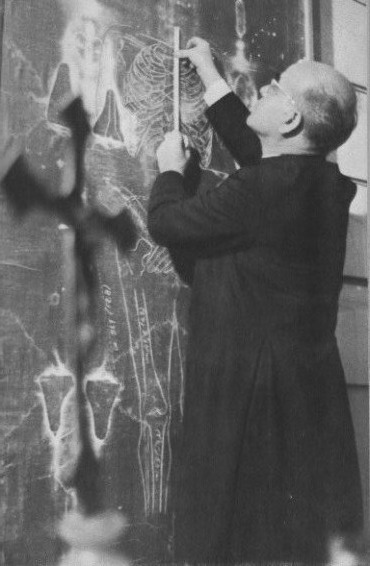
- In Rome, Msgr. Giulio Ricci, a Vatican archivist, devoted a large part of his time to the study of the Shroud. He published his first book on the Shroud in 1950. He worked on the problem of measuring the height of the Man of the Shroud based on the length of its limbs. His result is rather surprising, five-foot and three-inch. That is well below many other studies.
- In London to meet Fr. Maurus Green who was exchanging ideas with Ian Wilson on an intuitive theory that the Image of Edessa was actually the Shroud of Turin. This theory -- some will say scenario -- appear plausible and is supported by several historical documents.
- Paris to search the Gayet collection, at the Louvre, for any imprints of a body or human face on some Egyptian cloths: None was found. This has been a recurrent question: Was any imprint of a body ever found, on a burial cloth, beside the Shroud of Turin? No such imprint has ever been found. Since then, a similar imprint, not on a burial cloth per se, but on a mattress was found: the "Jospice Imprint", an imprint of hand, and partial body parts, on a mattress, of a man who died in a Liverpool Hospice in 1981. See The Imprint.
- Nottingham to meet D. Allen-Griffiths (who published Whose image and likeness? in 1964)
- At Esopus (in New York state) to view the largest collection of Shroud materials in America -- the Wuenschel collection named after Edward A. Wuenschel, a Redemptorist priest -- at the Mount St. Alphonsus Redemptorist Seminary.
- In Port Chester to meet Father Peter Rinaldi. We learn that Father Rinaldi's first book, published in 1940, sold almost 100000 copies. A large success for that time.
- In Miami, phone calls to Dr. Harold E. Davis, when showed the Enrie photographs, he mentioned that they resemble X-rays.
- In Washington, to meet T. Dale Stewart at the Smithsonian National Museum of Natural Sciences, an anthropologist. Stewart could not be very specific about the ethnicity of the man of the Shroud since he had no profile of the his face. Wilcox mentions that Leo Vala, a photographer expert who pioneered "3-D photography", had made an reproduction allowing sculptor to derive a 3-D head.
- In San Diego to meet Dr. Robert Bucklin,
- In Los Angeles to meet Ralph Graeber and Dr. Willard Libby, the Nobel Laureate who invented the first reliable radio-carbon dating technique. Libby mentions that he was approached to date the Shroud using his technique, but that he did not hear anything since then. (Note: the Shroud was radio-carbon dated in 1988, and Libby was not involved in it.)
- In San Francisco,
- In Boston to meet Richard Orareo, owner of one of the largest Shroud-related collection, bought from the estate of Herman J. Doepner. When retiring in 1956, Doepner decided to undertake a scientific study of the Shroud -- meanwhile gathering shroud-related materials: books, magazines, newspaper articles, photographs, etc. But Doepner never published his findings. Richard Orareo is still an active Shroud researcher -- he was present at the 2005 Shroud Dallas Conference.
- In Brookline to meet Dr. Constantine Cavarnos, a lecturer on Byzantine icons. Cavarnos could not agree with Wilson and Green's theory that the Edessan Image could be the Shroud, as he believes the Edessan Image had only a face, not a whole body. (Since then, Wilson and others have given very plausible explanations for the lack of numerous descriptions of the Edessan Image as a full human body -- e.g., the Edessan Image is often described as a folded piece of cloth.)
- New York City to meet Dr. Dov Zlotnic, professor of rabbinic literature at Manhattan's Jewish Theological Seminary. Zlotnic proposed some solutions for the creation of the Shroud image: the image would be a left over from a painting, sun shining through a stained-glass window for a long time. (Interestingly, such a technique was recently used to create a crude Shroud-like image.) On his expertise: he could not see how the Shroud could be in contradiction with burial Jewish custom; although he would need more time to give a more detailed answer.
A final note: page 31 presents a fascinating picture of Msgr. Giulio Ricci doing a length measurement on a life-size Shroud photograph. He is standing with a tape measurement in hands, carefully reading the tape over the abdomen of the man of the Shroud. Interestingly, we can see that a skeleton had been superimposed on the Shroud photograph. I have been promoting the idea of using a better system to report measurements (see Length Measurements). I was pleasantly surprised to see such an intensive looking Shroud scholar doing such a mundane task as length measurement on a shroud image.
 |
| Photo Giulio Ricci |