A new documentary on the Shroud will be presented for a limited time from Saturday June 7 on the ARTE platform (Europe). Lasting 90 minutes, it features several speakers in several countries, including France, Italy, America, Turkey and Israel. The audio is in French, but some web browsers (e.g., Chrome) provide live translated subtitles into English: see the Accessibility options of your web browser.
Innovative, this documentary is the first, to my knowledge, to present the thesis of the passage of the Shroud through the Sainte-Chapelle in Paris. Unfortunately, the subject is treated so superficially that it is almost impossible to grasp its foundations. Fortunately, the film does not address
implausible historical hypotheses, such as the supposed acquisition of the Shroud by the Knights Templar or the knight Othon de La Roche.
The documentary features Luigi Garlaschelli's alleged reproductions of the Shroud. Not only are these visually very different from the Shroud, but the fundamental aspect of examining linen fibers is ignored. Proof of a true reproduction of the Shroud would require photomicrographs of the threads, to confirm the absence of pigments or residues and to establish technical similarity.
The documentary includes misleading statements by historian Andrea Nicolotti. He portrays Henri de Poitiers, Bishop of Troyes, as an opponent of the Shroud during the first ostensions of the 14th century. The facts, however, contradict this assertion: the bishop always maintained cordial relations with the Lirey canons and actively supported the cult at the chapel.
Will the New Year 2025 bring any breakthroughs or revelations about the Turin Shroud? By whom and on
what subject? I have no prognosis, either precise or certain. Precision remains uncertain, and
certainty is always imprecise.
However, it is possible to provide some precision on the expectations related to the Shroud, whether
they are realized or not. The first concerns the ostension, which will not take place in the
long-awaited format. Instead, it will take the form of a virtual ostension, avoiding the need for
travel. It could be the largest gathering of virtual pilgrims since the Shroud came into
existence, but many were hoping for an onsite ostension.
There is also the symposium promised for this summer in Saint Louis, Missouri. The program is
underway, but we're already seeing the return of familiar themes: the image being formed by an
incomprehensible collapse of the Shroud, Otto de La Roche receiving the Shroud from who knows whom
and bringing it back to France via a speculative route, the Templars guarding the Shroud who knows
where, and many other subjects. However, many would like to add more details to these historical
hypotheses. Unfortunatly, new speculations are invented with no sources, superfluous historical
elements are added and ancient documents reinterpreted to fill in the gaps. Meanwhile, the search
for new ancient documents is neglected. Can we expect a breakthrough in our understanding of the
history of the Shroud? Some says no, all relevant documents would have been discovered. In any case,
no certainty is possible, as everything is based on hypotheses. Can we at least debate the subject
to get a clearer picture? That wouldn't be a good idea, as it would be criticizing friends. I think
there are fundamental errors in this methodology.
The irony of names and events: Saint Louis, King of the Franks, would no doubt have loved to
contemplate this extraordinary relic. Yet he focused all his attention on the Crown of Thorns, in
which he placed all his hopes for the Second Coming of Christ. Although he had acquired twenty-two
of the most precious relics from the imperial palace in Constantinople at a high price, and had
built the majestic Sainte-Chapelle in Paris to glorify France in the eyes of Christendom, he didn't
seem to feel any disappointment at not possessing the Shroud that Otto de La Roche would have
obtained in Constantinople. But did he really own it? After all, there was no proof of ownership in
the 13th century, any more than there is today, despite the claims of some. All the evidence
suggests that it was elsewhere. Could Saint Louis have possessed the Shroud in the Sainte-Chapelle
without even being aware of it? The idea is fascinating, almost fabulous. Yet, although the
Mandylion had been deposited in the Sainte-Chapelle, neither the king nor the canons seem to have
identified it as such. That's an observation to think about: Saint Louis knew nothing of the
Mandylion, nor did his cousin Baldwin, Emperor of Byzantium, who also failed to recognize
it. Unfortunately, this ignorance reflects a reality that is still common today: a lack of in-depth
analysis by sindonologists of this relic at the Sainte-Chapelle of Paris.
Perhaps new documentaries will be produced. This is almost certain, given the invaluable publicity
generated by this virtual ostension. But what will be the quality of the speakers? Will there be
prodigious special effects? A visit to the tomb of Christ in Jerusalem? A presentation in Lirey? Or
perhaps, a miracle, an interview at the Sainte-Chapelle of Paris? It's all possible, but we can't be
sure.
We can hope that the Turin authorities will be more open to research. However, we're likely going to
be sorely disappointed, as nothing has changed for decades. Although there is preserved material
from 2002, it has been decreed inaccessible to anyone. But then, to whom and for what purpose could
it be destined? Is there a fear that a discovery could be made without the possibility of controling
its dissemination?
We begin 2024 with some never published material directly related to the Shroud of Turin:
photomicrographs of the Shroud taken during the summer of 2002.
The six photomicrographs in Figure 1 were taken over a bloodstain, on the Shroud of Turin during
its restoration in the summer of 2002. They were extracted from one of the many videos taken during
that restoration using a camera mounted on a bidirectional track (see Figure 2). That explains a
degree of their out-of-focus aspect. Their level of magnification is greater than all the
photomicrographs taken by Mark Evans during the five-day STURP study in 1978 (see
the Mark Evans photomicrographs and on
the
Shroud Scope). This magnification allows us to see more details at the level of the fibrils of
the linen threads. For example, the red blood particles clearly agglutinate in very small specks,
which is expected from blood. In the collection of Mark Evans, that can be envisioned on only one
photomicrograph, but cannot be seen at the level of the
fibrils (see the ME-06 photomicrograph ).
Figure 1. Six photomicrographs extracted from one video taken during the restoration of summer 2002.
The video camera went over the main bloodstain on the right side of the chest as
shown by segment 44 on the left Shroud map of Figure 3d.
Kindly provided by Karlheinz Dietz courtesy of Giuseppe Ghiberti (click images for enlargements)
Figure 2. The camera mounted on a bidirectional track. Photograph kindly provided by Karlheinz Dietz. (click the photograph for an enlargement)
The videos are described on pages 133 to 136 in the book Sindone 2002, authored by Mechthild
Flury-Lemberg, published in 2002 (see Figure 3 for these four pages). In the appendix on page 133,
they are described as Videomicroscopic Photographs of the Shroud (Figure 3a) with a detailed list
of the locations on pages 134 and 135 (Figures 3b and 3c), with timing and operators, and on page
136 with two photographs, the recto and verso of the Shroud, showing the locations captured by the
videos with numbered line segments (Figure 3d). There are 24 videos from the verso, and 38 videos from the
recto, for a total of 62 videos. The photomicrographs shown in Figure 1 are from segment 44 on the
Shroud map shown on page 136, shown in Figure 3d.
As shown in Figure 3d, on the second map on the right with segments numbered 1 to 24,
there are many videos taken on the verso, that is, the underside of the Shroud where there is no
image but mostly bloodstains that seeped through the cloth. Photomicrographs that would be extracted
from them would be unique on that side of the cloth because such photomicrographs were never taken
before 2002.
3a
3b
3c
3d
Figure 3. Pages describing the videos and their location on the verso and recto of the Shroud. (click images for enlargements)
Naturally, the six photomicrographs shown on this web page are not the only photomicrographs we
could extract from these videos taken in 2002. I had access to only a few minutes of them, although
there are around two hours of such videos as compiled on page 135 with the timing of the
videos. What other interesting photomicrographs that could be extracted is unknown to me, because,
as far as I know, the other videos were not analyzed for such photomicrographs. They are kept by the
authority of the diocese of Turin and are not made accessible. I could not find any good reason
why they were never analyzed or used by the authority of Turin for promoting the Shroud. I know
that some researchers close to the authority of Turin consider these videos useless, which I think
is an incorrect assessment as can be attested by these six photomicrographs.
It appears to be such a waste of effort to have done all these videos in 2002 without doing anything
with them, not even analyzing them and producing a report. Is it because the Pope does not allow the
distribution of such information as the authority of Turin claims? That appears doubtful. It
rather appears that the authority of Turin fears that this data could be used in an inappropriate way.
But such a fear is unwarranted given that this data tends to show unique details reinforcing the
genuine aspect of that cloth as a shroud, and not even close to any artistic rendering.
These videos can be used to go beyond the Mark Evans photomicrographs to show many details of the
image on the Shroud, such as its superficiality. Other discoveries could be ascertained such as the
possible images of blood instead of the expected bloodstains, that is, what appears as bloodstains
are probably images of bloodstains. It would also be very interesting to look closely at the
photomicrographs right next to the radiocarbon dating location. Unfortunately, the authority of
Turin does not appear to have any interest of using these videos for such purpose.
There is a similar decision from the diocese of Turin regarding the high-definition photographs of
the Shroud. Several years ago, the Italian Haltadefinizione company was contracted by the diocese to
scan the Shroud to obtain a high definition image. It was possible to order large printed
reproductions of that photograph. The company also developed the application Shroud 2.0 that
allowed for visualizing the Shroud at a very high definition on iOS devices. That was similar to the
Shroud Scope available on this web site
(see Shroud
Scope ). That application from Haltadefinizione was sold at a very low price. According to
Haltadefinizione, the authority of the diocese of Turin did not renew the contract to sell Shroud
2.0, the production of printed copies of the Shroud, and showing the Shroud on their web site. All
the Shroud 2.0 applications already sold became non-functional as it depended on a computer server
controlled by Haltadefinizione. Why the authority of Turin decided to discontinue Shroud 2.0 and
the sales of printed high-definition photographs by Haltadefinizione? I do not know and my
inquiries remained unanswered.
In December 2022, Karlheinz Dietz and I submitted a short paper to
the newsletter of the British Society for the Turin Shroud (BSTS)
answering critics of M. Ian Wilson regarding a paper we had
published in the summer 2021 newsletter
titled The accidental arrival of the Shroud at
Lirey. The short paper, which the new editor Michael
Kowalski decided to show to M. Wilson, was rejected because
supposedly it repeated arguments and contained "quite personal
criticisms about his [Wilson] work". That statement is quite
incorrect because there are no "personal criticisms" in that short
paper, which the reader can verify from the copy at ResearchGate
(see below), and the short paper pointed out new essential errors
written by M. Wilson. The short paper does indeed criticize the work
of M. Wilson, but they are not "personal". We concluded that
M. Wilson is not interested in detailed scholarly discussion and
that the BSTS newsletter is not a venue for in-depth scholarly
discussion on the Shroud.
We have made available this short response to Wilson's
critics at ResearchGate A response to Ian Wilson's comments on the Sainte-Chapelle thesis. We hope you
will find it instructive, in particular of this special gift
looking like a large folded cloth that King John II gave to Humbert II
de Viennois (the old Dauphin), in January 1352, and that Geoffroy de Charny was made
a witness. We stated the following hypothesis: could that be the Shroud,
which by some fortuitous circumstances became the property of Geoffroy instead
of Humbert II?
The French association Montre Nous Ton Visage (MNTV) has renewed its
website at the new
address linceul-de-turin.fr. The association publishes its
Cahier (Newsletter), containing numerous articles about the Turin Shroud, twice a
year, in summer and winter. You can join the association by
subscribing to the Cahier using this new website.
Home page of the new website of the association Montre Nous Ton Visage (MNTV).
The new website provides access to the most recent publications and
the Cahiers and offers a free download of all Cahiers archived since
the first issue in 1988. (Please visit Cahiers MNTV)
For example, you can download for free the issue of
December 2019 containing a very informative article
by Jean-Christian Petitfils on the "historical hole" (1204-1355) of
the Shroud of Turin; or the issue of December 2017
containing an article covering the thesis of the passage of the Shroud
through the Sainte-Chapelle of Paris.
For more information, please visit this new website by clicking one of
the links presented, such as the MNTV homepage.
Professor Emeritus Karlheinz Dietz has written numerous
high-quality papers on the history of the Shroud of Turin. He is also
one of the rare researchers to have seen the Shroud up close and out
of its protective case for several days during the restoration of the
Shroud in the summer of 2002. His papers may not be well-known to
non-German readers as they are predominantly written in German. I
present a shortened version of Karlheinz Dietz's paper on the
hypothesis of the Templars (“The Templars did not own the Shroud
of Turin”), which was translated into English and revised by
Johannes Dietz and Dietmar Wuksch. I also made some editorial
modifications approved by Karlheinz Dietz. The original, longer paper
written in German, was published in 2017 (see the end of the shortened version for
details).
The paper addresses various elements of the hypothesis, such as the
existence of a high-ranking Templar named Geoffroy de Charnay, who was
burned at the stake with the Grand Master Jacques de Molay in
1314. However, there is no evidence linking that Charnay and Geoffroy
de Charny, lord of Lirey and Savoisy, the first recorded owner of the
Shroud in France. The name “Charnay” and its variants such
as “Charny”, and “Charni” were common in
medieval times. Moreover, the granddaughter of Geoffroy de Charny,
Marguerite de Charny, testified in court that the Shroud came from her
grandfather, ruling out the possibility that the Shroud came from
another member of the Charny family. This statement also excludes
Geoffroy de Charny's wifes, Jeanne de Toucy and Jeanne de Vergy, as
the possible origin of the Shroud in the Charny family.
A symposium on the history of the Shroud of
Lirey-Chambéry-Turin will take place in March 27-28, 2020, at
the archives of the Department of Aube, in the city of Troyes,
France. I am organizing the symposium with the help of the local
historian Alain Hourseau from Bouilly. The symposium will take place
in the building of the reading rooms of the archives situated outside
downtown Troyes. All talks will be in French and take place on the
first day of the symposium, Friday, March 27.
The second day, Saturday, March 28, will be a social event visiting
the villages of Lirey and Savoisy. At Lirey, we will visit the chapel
where a history of the collegiate will be presented. We will also
visit the feudal motte where Geoffroy de Charny built his castle (a
special access to the private land including the motte was obtained by
Alain Hourseau). Although the castle is completely gone, we can still
see the ditch that protected it. This will give the participants a
first-hand historical background of what approximately the collegiate
of Lirey was in the 14th century. At Savoisy, our visit will be hosted
by Laurent Bouzoud and we will visit the outside of the castle. A
presentation on the history of the castle and the role it possibly
played on the Shroud will be presented by Laurent.
For more information and reserve a place to the symposium, please
visit the Eventbrite website.
The Centre International d'Etudes sur le Linceul de Turin (CIELT)
has published a newsletter, called Revue Internationale du Linceul
de Turin (RILT), for more than 20 years. It contains French and
English articles about the Shroud of Turin. The CIELT also organized
several symposiums on the Shroud of Turin, at which French, English
and Italian talks were presented. The RILT and the proceedings of
these symposiums are now available online on the French website
at linceul.org.
Look for the icon "CIELT" or click the icon below to reach the CIELT
section on that web site.
Excerpt from the first page of the manuscript "Pour Scavoir la Verite". Manuscript L 746/2/1, Archives nationales de France (AnF).
A new section was added to the French web site at the following
link Linceul.org, about an important historical
document: "Pour Scavoir la Vérité". It was written
around 1525 and most probably by the dean of the collegiate at
Lirey. He declares that the Shroud was given to Geoffroy de Charny by
King Philip VI, for his attempt to regain the city of Calais. When
analyzed carefully, this is the most probable route of the
Shroud. Philip VI had exclusive access to the most important relics in
the Sainte-Chapelle of Paris and one of them was a Holy Cloth. That
Holy Cloth was most likely the Mandylion of Constantinople, but the
King, and the clerics at the Sainte-Chapelle of Paris, were unaware
of the preciousness of that relic.
The manuscript is in French, but as usual you can use Google to
translate the web page and read the transcription and a modern French
version of that transcription. The Google translation of the
manuscript in English is very far from being perfect, but the comments
I wrote about it is understandable. Note that Dorothy Crispino
published in 1988 a translation of that document in English. I give a
pointer to that text on that French web page. For anybody interested
in the history of the Shroud, that document is a must read.
Several new entries were added to the French web site
at Linceul.org,
including a new section on the small village of Lirey where the Shroud
was first displayed in France. Remember that the web pages can be
automatically translated to English by selecting the English language
on the top of any web page at the French web site.
The latest issue of the newsletter (cahier) Montre Nous Ton
Visage (MNTV) of December 2017 includes a long article on the
thesis of the Sainte-Chapelle. Please
see Linceul.org/sainte-chapelle.shtml for more
information about that article and the MNTV web
site MNTV for the
latest issues of the newsletter.
A third pilgrim medallion of the Lirey church has been recently
discovered. We already know the existence of two different
Lirey medallions, one kept at the Cluny museum in Paris, the other is a mold
of medallions found in Machy, near Lirey
(see
medallions).
Alain Hourseau, who lives near Lirey, sent me a
photograph of one side of this new medallion, which can be more accurately
described as a rounded medal. We can clearly see a cleric, with a
miter and formal attire, holding the Shroud, but showing only the
frontal part, not the double body image. The Shroud is not shown in
detail as on the first medallion at the Cluny museum. On the other
side of the medal is a representation of the Virgin, which is
understandable because the Lirey church was dedicated to the
Virgin. Hopefully, in a few days, I can post a photograph of both
sides of the medal.
The International Conference on the Shroud of Turin, Pasco, Washington,
was held July 19 - 22. Three full days of talks covered many fields, including
history and image formation. The speakers came from several countries, including
Spain, Italy, Australia, USA, and France. Videos of the talks are available
from Shroud Encounter.
The rediscovered wood chest that was used to store a smaller chest that contained the Shroud of
Besançon. This wood chest is mainly made of sandalwood, the second
most expensive wood in the world and used by the cosmetic industry for its fragrance oil
(see Santal 33 perfume). Dimensions: 21.8 cm x 48.3 cm x 21.4 cm.
The chest used to store a smaller chest that contained the
Shroud of Besançon was recently rediscovered. This chest was in the
cathedral of St John when the Shroud of Besançon was still
shown publicly, at least twice a year, to the crowd outside the cathedral. That
Shroud was destroyed during the French Revolution along the smaller
chest that contained it. The Shroud of Besançon was clearly a
painted copy of the Shroud of Turin with only the frontal part.
The identification of this coffer is based on an ancien description of
the coffer that was kept in the chapel dedicated to the Shroud of
Besançon, in particular the presence of the three locks. This
chest would date from around 1523 when it was first recorded that a chest was used to
secure the Shroud of Besançon. An exhibition about the Shroud
of Besançon organized in September 2016 at the St John's
cathedral had as its center piece the rediscovered chest.
I started a new French
web site dedicated to the Shroud of Turin. It will focus on the
history of the Shroud and French articles, manuscripts and news related to the
shroud. The first entry is on
an article written by Hilda Leynen on the presence of the Mandylion at
the Sainte-Chapelle of Paris. It is the first article that analyzed
the details of the inventories of the relics to show that a
Holy Cloth disappeared from the relics of the Grande Châsse
at the Sainte-Chapelle. This disappearance is coherent with the statement
made around 1525 by the canons of Lirey that King Philip VI gave the Shroud
to Geoffroy de Charny.
In the notice Pour scavoir la verite, written around 1525 by
one of the canons of the collegiate at Lirey, its author states
clearly that the Shroud, known today as the Shroud of Turin, was given
by King Philip VI to Geoffroy de Charny for his tentative to regain
the city of Calais on the first day of 1350. The tentative was not
successful, and Geoffroy was captive for 18 months in London. On his
return to France, did Geoffroy finally brought the Shroud to Lirey?
That would have been in mid 1351. Was Geoffroy even aware of the
presence of the image on the Shroud by this time? A few years later,
the Shroud was publicly exposed at the small wooden church of the
collegiate at Lirey.
How did King Philip VI obtain the Shroud?
All evidences show that we do not have to look further than the
private collection of the King: the relics kept in the Grande
Châsse at the Sainte-Chapelle of Paris. It was the most
prestigious collection of relics in Christendom. We still have the
inventories of the relics taken over several centuries. The inventory
of August 1740 reveals that the reliquary where a cloth had been kept,
had lost its content. That cloth was the Mandylion of Constantinople.
The description is all about the reliquary and of a portrait of Christ
at the bottom, a Veronica. The officials making these observations do
not identify any cloth. They do not indeed separate the presence of
the Veronica from the reliquary because the Veronica is described as
appearing directly on the bottom of the reliquary. That Veronica is not
described as being on a cloth. And none of the previous inventories,
up to 1534, describe the image on a cloth. All appearances show that
the cloth had disappeared before 1534.
Figure 1: Item 19 of the August 1740 inventory of the
Grande Châsse at the Sainte-Chapelle of Paris. The French text
describes the reliquary in which a cloth had been inserted when it
arrived in Paris in 1241 (“Sanctam toellam, tabulae
insertam” as given by the 1247 official letter, signed by the
Latin emperor of Constantinople, Baudoin II, ceding the relics to
Louis IX, King of France). The reliquary is a rectangular box of
about 60 cm by 40 cm, and has a portrait of Christ's face on the
bottom with golden plates all around it. However, in this inventory,
no cloth is mentioned. (Click the image for a larger view)
Figure 1 shows an extract of that inventory. The manuscript
is kept at the National Archives of France (Archives nationales de France (AnF)).
It is item 19 of a list of 21 items.
Remarkably, right after the description of item 19, item 20 refers
to a reliquary containing hairs of the Virgin, the same type of relic
deposited at the church of the collegiate at Lirey. Figure 2
shows an excerpt of the manuscript describing this reliquary containing
the hairs of the Virgin.
Figure 2: Item 20 of the August 1740 inventory of the relics from the Grande
Châsse (Archives nationales de France, AnF). It describes a reliquary
containing what is believed to be hairs from the Virgin. (Click the image for a larger view)
The third relic deposited in the church at Lirey was a piece of the
True Cross, which was also a relic in the Grande Châsse. King
Philip VI had complete control over the relics and he could use this
collection according to the need of the Kingdom. Accordingly, the
simplest and most natural origin of the three relics of Lirey,
including the Shroud, is the Sainte-Chapelle of Paris.
A conference on the Shroud of Turin, organized by Bob Rucker, will
take place in the state of Washington in the summer of 2017, July 19 -
22. For more information on paper submission and attending, please
consult the web site.
The complete underside of the Shroud of Turin had been hidden from
observation for more than four centuries until the summer of 2002,
when the Holland cloth was unstiched during the restauration of the Shroud.
While the underside was completely accessible, it was photographed,
which provided the first ever complete photographs of the underside of the
Shroud. These photographs were published in a few books, in particular
by Opera Diocesana Preservazione Fede (ODPF).
The following photograph (Figure 1) presents the middle section of the
underside of the Shroud where the bloodstains from the back of the head
and torso, the face, and front torso, are visible. There is no
perceptible image as can be seen on the well-known front side. Some
researchers claimed that a dim image of the face appears on this
underside, but this is controversial. Figure 2 shows a close-up
view of the face region of the underside.
Such a photograph allows a deeper study of how the image was formed
or not formed. For example, the obvious observation is that no
perceptible image can be seen on the underside, which entails that if
paint was ever used to produce the image on the front side, it could
not have been painted the usual way, because paint would have
transferred to the underside by capilarity. Another example is the
amount of blood transferred on the underside from the bloodstains in
the hair region of the front side. No major amount can be seen on the
underside, which is coherent with the bloodstains realy coming from
the hair.
At the beginning of the 20th century, Ulysse Chevalier, a French
historian, was involved in the newly created controversy of the first
photographs of the Shroud, taken by Secondo Pia in 1898. He wrote
several history papers and monographs claiming that the Shroud was not
authentic. Ulysse Chevalier was mostly interested by the history of
the Shroud and pay little attention to the physical characteristics of
its image, but in one of his monograph [1](p. 19), he claimed that the
photograph taken by Secondo Pia did not show the correct side because
Chevalier thought that the bloodstains and the hands were
inverted. That is, Secondo Pia would have taken a photograph of the
side that had a dim image, creating its enigmatic appearance, and that
the other side would have a brighter image, which would not have its
enigmatic image and better show that it was a painting. Chevalier's
contention was wrong as the underside has no perceptible
image but mostly only bloodstains.
Ulysse Chevalier, Le Saint Suaire de Turin/Histoire d'une Relique, Alphonse Picard Editeur, 1902. (External link To Google Book)
The Pierpont Morgan Library & Museum in New York City has a large
collection of illuminated manuscripts. Among them is
the manuscript
499, a parchment roll of about 3.3 m long and nine cm wide. Its
skin-side is written in Greek with twenty illuminated miniature scenes
depicting the Legend of King Abgar, its hair-side is a
translation of the Greek text in Arabic with no miniatures, although a
cross is drawn on the hair-side on the segment kept at the University of
Chicago (see below). Its production has been dated in the third quarter of the
fourteenth century, but certainly not later than 1383, because the
author of the Arabic text states that year for his translation. The
roll was an amulet. Originally, it was likely owned by a Byzantine
military officer, then in 1383, owned by a Christian, Suleyman ibn
Sara, because the colophon of the Arabic text says so.
Figure 1 shows the scroll mounted on two custom-made rolls in a
protective case. For its age, the manuscript shows remarkable good
conservation, although the miniatures have lost some paint. The tiny
Greek writing is still crisp and clear, see Figure 2.
As part of the Legend of King Abgar, Christ sends
an image of himself to King Abgar. That image is known as the Image
of Edessa also known as the Mandylion. Actually, the legend evolved
from an image painted by a messenger sent by King Abgar to an image made by Christ
himself. The Mandylion can be seen in several of the miniatures of
M.499. Because this manuscript M.499 was produced after the sack of
Constantinople in 1204, it is almost certain that the artist who
created the miniatures never saw the Mandylion itself. Furthermore,
the manuscript was probably produced in Trebizond, if not, it was in
Constantinople. Actually, one may ask the general question: had any
artist, who reproduced the Mandylion, seen the real Mandylion before
the sack of Constantinople? The answer is likely negative. The many
artistic representations of the Mandylion that we still have today
are probably based on hearsay and on the legend of King
Abgar. Manuscript M.499 would be a documentary evidence supporting
this claim, because we can see in it the typical artistic
reproductions of the Mandylion similar to many others produced
before 1204, yet the artist of M.499 can hardly have seen the real
Mandylion.
The twenty miniatures of M.499
can be seen on the website of the Pierpont Morgan Library. The manuscript is divided in
twenty sections, each with a miniature scene.
In the entire manuscript, four scenes show clearly the
Mandylion, where only the head of Christ is visible, and one scene where the Mandylion is mostly hidden:
In Section 9, Ananias receives the image of Christ on a cloth, i.e., the Mandylion, directly from Christ;
In Section 10, the Mandylion, on its journey from Jerusalem, is temporarily hidden between two bricks;
In Section 11, the Mandylion is being revealed after it was temporarily hidden;
In Section 12, the Mandylion is in a scene of a miraculous healing;
In Section 14, Ananias reveals the Mandylion to King Abgar. See Figure 3.
The roll is incomplete because the beginning segment is missing and
it is kept at the library of the University of Chicago as
manuscript
125. That segment is about 1.7 m long with seven miniatures
representing Mark, Luke, John, Christ, Christ and
the Virgin, the Trinity and David as King of Israel. The Chicago fragment does not contain
any scene involving the Mandylion.
For a good description and analysis of the manuscript M.499, see [1], which has a lengthy bibliography.
The Mandylion/Image of Edessa was most likely a real cloth with an
image of Christ, which is transferred from Edessa to Constantinople in
944. It had been kept in Edessa for many centuries. When the Image of
Edessa arrives in Constantinople, it is kept in the Imperial Palace
and hidden from public view. Its whereabouts is not clear after the
sack of Constantinople in 1204, but it is likely transferred to the
Sainte-Chapelle of Paris in 1241 after Baudoin II, the desperate Latin
Emperor of Constantinople, sold twenty-two relics to King Louis
IX. Indeed, the inventories of the Sainte-Chapelle describe a
reliquary with a face of Christ at the bottom and containing a cloth.
The manuscript “Pour scavoir la verite,” written
around 1525, says that the shroud of Lirey, today the shroud of Turin,
was received from King Philip VI. The simplest explanation for the
provenance of that gift is the Sainte-Chapelle of Paris, because that
is the main repository of the relics of Christ of the King of France.
The only relic of the Sainte-Chapelle of Paris that can correspond to
the shroud of Turin is the Mandylion.
References
Nadezhda Kavrus-Hoffmann, Catalogue of Greek Medieval and Renaissance Manuscripts, Manuscripta 52:1 (2008),
pp. 125-140.
The Mass Spectrometry Analysis of Shroud Linen Fibers by Raymond Rogers
In 2005, Raymond Rogers published, in Thermochimica Acta, a study
of linen fibers from the Shroud. That study concluded that gum Arabic
had been used on the fibers near the radiocarbon dating sample used in
1988 to date the Shroud. The overall conclusion of that study pointed out
that the area around and including that sample was mended or at least
was different from the rest of the Shroud.
More recently, Marco Bella, Luigi Garlaschelli and Roberto
Samperi wrote an editorial paper
criticizing the mass spectrometry analysis of that study, concluding
that no gum Arabic was detected on the fibers but that instead
an unknown contaminant was detected on the sample.
Actually, these criticisms by Bella et al. are misleading, which is
discussed in a short communication just published in
Thermochimica Acta. Its main conclusion is described in the abstract:
In a recent editorial paper of this journal, Bella et al. commented on
the mass spectra analysis done by Rogers, which consisted of two
mass spectra of the pyrolysis of linen fibers from two areas of the
Shroud of Turin. The main conclusion of Bella et al. was “No
diagnostic peak in the pyrolysis mass spectra indicates a significant
difference in the two samples, besides hydrocarbon-derived
contamination. Therefore, none of the presented data supports the
conclusion by Rogers.” We show that the technical analysis of Bella et
al. of the mass spectra is incorrect and that their main conclusion is
unconfirmed, in particular that a “contaminant” would be present on
the second sample analyzed.
This short communication is freely accessible until Feb 12, 2016.
The hypothesis that Othon de la Roche acquired the Shroud of Turin,
during the conquest of Constantinople in 1204, has been proposed for
many centuries. We read that due to its great services during the 4th crusade,
Othon was given the Shroud in 1204, kept it in Athens, and that it was
brought back at the castle of Ray-sur-Saône or to the castle of his father.
But that hypothesis can be shown to be false. The misconception sprang from a
lack of knowledge about the original documentary sources.
The thesis of the Sainte-Chapelle has been proposed by
André-Marie Dubarle and Hilda Leynen to explain the transfer of the
Mandylion from Constantinople to Lirey, which became the Shroud of
Turin. It is a very coherent, direct and well documented
thesis. The thesis is even more coherent when all the inventories of the relics of the
Grande Châsse of the Sainte-Chapelle are carefully
analyzed. I have little doubt that it is the correct basis from which
we can coherently explain the appearance of the Shroud of Turin in
Lirey.
Compared to many other thesis, including the involvement of
Othon de la Roche or the Knights Templar, it is a well documented
thesis with a direct route from Constantinople to Geoffroy de Charny,
who brought the Shroud to Lirey. It is coherent with the statements
made by the canons of Lirey as well as the son and granddaughter of
Geoffroy de Charny. It also explains in a very simple manner the
153-year silence of the Mandylion that became the Shroud of Turin.
It is even hard to believe that such a coherent thesis has been so unfavorably
presented, with so many invalid arguments, since Dubarle and Leynen
described it.
It is now official, the castle Ray-sur-Saône, its furniture and its
park are now owned by the department of Haute-Saône. That implies that all
future visits of the castle will be under the control of the
department. For more details see Le château de Ray-sur-Saône offert au conseil
départemental.
Countess Diane-Régina de Salverte is the last owner of the
castle. Although not stated in the newspaper article (see link above),
the Countess will possibly still live in a part of the castle.
One of the long time ago owner, in the 13th century, of a castle on
the same location was Othon de la Roche who participated in the Fourth
Crusade. Many authors stated that Othon was probably the owner of the
Shroud of Turin while he was Duke of Athens. This possibility is
actually very unlikely because it is based on a manuscript of the 18th
century, kept in the Municipal Archives of Besançon, that has no solid
foundation.
The castle of Ray-sur-Saône is located about 200 km southwest of Lirey
and 50 km north of Besançon. It is often cited in the history of the
Shroud of Turin because it belongs to descendants of Othon de la
Roche, a knight who would have acquired the Shroud during the Fourth
Crusade (1202-1204). The castle houses a copy of the Shroud of Besançon,
which was a partial copy of the Shroud of Turin (ventral part only),
and a small chest that would have been used, so it is said, to bring
the Shroud from Greece to France in the 13th century.
Despite several historical hypotheses of the Shroud that have been
put forward involving Othon de la Roche, it is very unlikely
that Othon had anything to do with the Shroud of Turin. The main
reason for this conclusion is that the seed of all these hypotheses is
the dissertation in favor of the authenticity of the Shroud of
Besançon, written in 1714, contained in the manuscript 826 of the
archives of the Besançon library. That is, all subsequent historical
documents mentioning Othon de la Roche as possibly having owned the
Shroud are based directly or indirectly on that dissertation. But that
dissertation has no solid foundation to state that Othon de la Roche
was involved with any shroud: the dissertation refers to documents
that never mention that Othon received a shroud or owned any
shroud. In other words, the author of that dissertation made up a
story about Othon de la Roche receiving a shroud during the Fourth
Crusade. The book Le Saint Suaire de Besançon
discusses these hypotheses and has a complete transcription of the
manuscript 826 (in French).
Moreover, the small chest still at the castle of Ray-sur-Saône
appears unlikely to have been used to bring any shroud back from
Greece. There is no written tradition from de la Roche family, or its
descendants, mentioning that such a chest was used. Several people,
including myself, tried to discuss this tradition with the last owner
of the castle, the countess Diane Régina de Salverte, but no such
discussion was possible. It is difficult to date the chest as no
authorization would be given to do so.
It is also odd that the copy of
a shroud in the castle is not of the Shroud of Turin but of the Shroud
of Besançon, which is not what one would do to honor this incredible
fact that the Shroud of Turin was brought from Constantinople by one
of your ancestors. If this copy is used, it is most likely because it
is based on the story coming from the manuscript 826 of Besançon,
which means that this copy is not based on family tradition but rather
from the writing of Dom Chamard, which in turn is based on the
dissertation in favor of the Shroud of Besançon of manuscript 826,
which we know is totally unreliable.
And any hypothesis stating that the Shroud came to Lirey through
Jeanne de Vergy (second wife of Geoffroy de Charny), who would have
been a descendant of Othon de la Roche, is fraught with other major
issues. For example, the receipt of Humbert de Villersexel, given in
1418 to the canons of the collegiate church of Lirey, states clearly
that the reliquary containing the Shroud had the coat of arms of de
Charny, not of de Vergy. The son and the granddaughter of Geoffroy de
Charny also stated clearly that the Shroud was from Geoffroy de
Charny, not from Jeanne de Vergy.
The castle was transformed several times and even, due to the Ten
Years war, it was destroyed then rebuilt. The castle used to have up to
twelve towers, but now has only two. The countess Diane Régina de
Salverte still lives at the castle but occupying only a part of it
because the ownership of the castle is in the process of being
transferred to the French administration (Département de la
Haute-Saône). Visits, for the general public, of the interior of the
castle have been suspended until this transfer is completed.
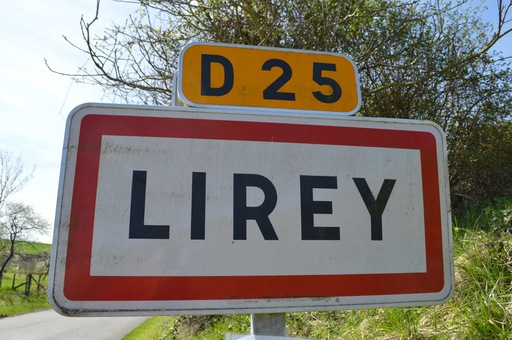
The first ostentations of the Shroud of Turin in the Western world
was in Lirey, a hamlet 16 km southwest of Troyes, the nearest large
city. Lirey is still today a hamlet with about fourty houses and a
19th century chapel located on the same piece of land where the first
chapel was built ca 1353. The first ostentations of the Shroud would
have been ca 1357. In 1418, the Shroud leaves definitely the chapel and Lirey to
be kept at the castle of Montfort under the protection of Humbert de
Villersexel, the second husband of Marguerite de Charny, granddaughter
of Geoffroy de Charny. The Shroud never came back to Lirey although
the canons of Lirey tried many times over a century to regain the
Shroud. A second chapel was inaugurated in 1525, which was demolished
in 1828. A third chapel was built at the end of the 19th century. The
following photographs show the inside and outside of this third chapel
at Lirey.
In 1353, the chapel was supervised by a small group of canons, the
collegiate, who lived nearby. In the following photo, on the right, is
the site where the collegiate building was located (the chapel, not
visible, is on the left). Notice the black small tower. It probably
dates back to the 16th century. It houses pigeons that were probably used for
communication.
The castle (or maison forte) of Geoffroy de Charny was further back
on a small slightly elevated piece of land encircled by a protective
trench filled with water. The trench is still visible today and water
is still keeping the visitors away. The collegiate and the castle no
longer exist and their pieces of land are now private. Thanks to Alain
Hourseau who made the appropriate arrangements to access the site
where the castle used to be located. The following photos show the
trench filled with water and the castle site filled with trees.
Page couverture du livre Le Saint Suaire de Besançon // Dissertations pour et contre son authenticité.
The Shroud of Besançon was as popular as the Shroud of Turin
for almost three centuries. It disappeared in 1794 during the French
Revolution.
The 18th century manuscript 826 from the archives of the
Bibliothèque de Besançon contains two
dissertations, one for its authenticity and one against it. The
dissertation for its authenticity has a proof of the origin of the
Shroud of Besançon from Constantinople, but not only that proof
has been critised by many researchers, its use to prove an historical
route for the Turin Shroud, based on Othon de la Roche, is shown to be
highly doubtful. Indeed, this dissertation, and its proof, was cited
numerous times by scholars and historians of the Shroud of Turin.
This newly published book presents a complete transcription of both
dissertations. The transcription of the first dissertation, for the
authenticity, is new because this dissertation was never published
before. A French description, from the back cover, is given below. An
electronic version of this book (for phones, tablets, computers) is also available.
Le Saint Suaire de Besançon fut très populaire pendant près de
trois siècles, attirant des foules considérables dès ses premières
ostensions au 16e siècle. Sa popularité est si grande qu'en 1705 le
roi Louis XIV ordonne la suspension des ostensions pour éviter que les
soldats allemands s'emparent de la ville en se dissimulant parmi les
dizaines de milliers de pèlerins étrangers.
Le Suaire de Besançon disparaît en 1794 lors de la Révolution
française, mais il subsiste de nombreux anciens manuscrits et
publications le décrivant. Le manuscrit 826 du 18e siècle des archives
de la bibliothèque de Besançon est composé de deux
dissertations distinctes qui poursuivent des objectifs diamétralement
opposés, la première plaidant en faveur de l'authenticité du Suaire de
Besançon et la seconde soutenant le contraire.
Ce livre présente une transcription inédite de la première
dissertation et une version modernisée de la seconde dissertation
publiée en 1831, accompagnée de commentaires.
Les auteurs de ces dissertations comparent le Suaire de
Besançon avec le Suaire de Turin, parfois pour déterminer
lequel serait authentique. Le lecteur pourra juger de la pertinence de
ces comparaisons et mieux découvrir ces deux Suaires. Il découvrira
aussi des éléments modernes de la seconde dissertation et en
particulier qu'un suaire authentique est plus crédible s'il produit
une image tridimensionnelle, une remarque très pertinente au regard
des développements scientifiques modernes sur le Suaire de Turin.
Quelle est l'origine du Suaire de Besançon? Était-il aussi
populaire que le Suaire de Turin? Est-ce que l'Histoire de ce Suaire a
été combinée à celle du Suaire de Turin? Le chevalier Othon de la
Roche est-il réellement à l'origine du Suaire de Besançon ou
peut-être est-il plutôt à l'origine de celui de Turin? Voilà
quelques-unes des questions fascinantes abordées dans ce livre.
L'auteur est chercheur en informatique et bioinformatique dans un
centre de recherche de la Silicon Valley. Il a un doctorat en
informatique-mathématiques de l'Université de Montréal et a publié de
nombreux articles scientifiques en informatique, bioinformatique et
mathématiques appliquées. Il est aussi l'éditeur du site web
sindonology.org sur le linceul de Turin. Il est l'heureux père de deux
charmantes filles.





 In 2005, Raymond Rogers published, in Thermochimica Acta, a


