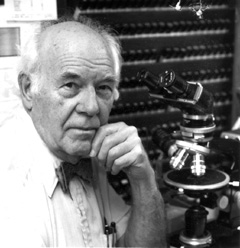
A Review of Walter McCrone's Judgment Day for the Shroud of TurinWalter C. McCrone, Judgment Day for the Shroud of Turin, Prometheus Books, 1999, 341 pages. (ISBN 1573926795)
Walter C. McCrone concluded in 1978 that the Shroud was a medieval painting. He published several papers in his own journal The Microscope to demonstrate his claim and ultimately published a book in 1999 presenting the results. That work, particularly that book, used to be often cited as a source for the inauthenticity of the Shroud of Turin. Although, nowadays the hypothesis that the Shroud is a painting is considered unlikely even by the skeptics. McCrone, who was a well-known microscopist, died on July 2002, at age 86. He is also well known to have concluded that the Vinland map is a forgery — a still disputed claim. His book was published long after his analysis and study of the Shroud was done—definitely long after his first paper was published in The Microscope. He considered it his final words about the Shroud. We should therefore expect his arguments and scientific findings to be well presented in this book. In 1997, Walter McCrone posted a message in a news group about his upcoming book. I asked him if he could provide a one page description of the essential elements of his arguments before I could order one. He kindly did so, but the provided results were unconvincing. Essentially, if an argument is made that the Shroud is a painting, and that microscopic observations were made that supposedly identified paint pigments, we would expect that 1) an amount of the found pigmets be given, 2) that the color of the pigments match the perceived color image. But not even these results were given. I ordered the book anyway to further study his claims. McCrone made his microscopic study based on 32 sticky tapes that were applied on the Shroud during the 1978 STURP study and brought back by Ray Rogers in Los Alamos where McCrone picked them up (p. 78). McCrone never had direct access to the Shroud and was not a member of STURP. Unfortunately, his book is badly organized as it is quite difficult to follow the thread of the author's reasoning. The author does not demonstrate in a straightforward manner the claims made and, as we will see, lacks essential data (e.g., no quantity of the pigments found is given), uses an incorrect methodology (e.g., knowing that some slides are over an image area he analyzed them endlessly searching for some pigments leaving the non-image area slides underanalyzed), confuses basic facts about the shroud (e.g., he did not see a difference between the bloodstains and image area on the Shroud which looks obviously different) and commit many other basic errors. What has been identified as paint pigment by McCrone has often been described by others as coming either from the blood on the Shroud or the water stains. We will see that indeed these stains are the most probable source of the iron oxide he found on the Shroud, and this from McCrone published data itself. As a matter of fact, McCrone never hypothesized this possibility and never looked at this possible relationship: a very basic error on his part. I summarize in the following list of errors committed by McCrone as given in his book:
A Real Perfect Match or Was It a Made Up Perfect Match?There is a clear erroneous claim made by McCrone: on page ???, there is a claim of a perfect correlation between sticky tapes which have traces of iron oxide and the fact that they were in contact with the image area. Moreover, all sticky tapes that came in contact with the image area have iron oxide on them, and all others do not have any . So, not only does he claim a perfect match, but a perfect binary relation — the sticky tapes that were not on the "image" have no traces at all of any iron oxide. Zero! This claim, to say the least, is very doubtful. There should have been a gradient: some of the sticky tapes should contain more iron oxide than others, but that is never presented in his book. His analysis would have been more believable if some amount of iron oxide for each tape would have been given. Apparently, this was too difficult to do. Which makes you conclude that the measurements of the amount of iron oxide is very imprecise. What does McCrone mean by "image area"? He includes the yellow image area (somatic image) and the blood stains. Not only is there an obvious difference in color between them but it has been proven that the blood stains have went through the Shroud, unlike the image. In his classification, McCrone makes no difference between the two. It is the same for the water stains — he ignored any relations that might exist between the water stains and what he finds on the tapes. Let us look at the location classification of sticky tapes according to McCrone. From Figure 14 on page 79, the reader has a complete picture of the Shroud with the locations of all sticky tapes analysed. From Table IV, on page 93, we have McCrone classification of sticky tape locations.
This starts badly to claim a perfect match: the classification of non-image and image area is wrong. How Much Iron Oxide Is on the Shroud?On page There should be a clear demonstration of this answer. Another example of circular reasoning on this matter can be found on page 97, beginning of section 13.0. I quoteBy this time [1979], an artist friend of mine, Walter Sanford, became interested in the Shroud image and learned to paint shrouds. I made up his paint 0.01% of red ochre in 0.01% gelatin protein. Are there Art Experts Supporting McCrone's "painting" Claim?One major damaging fact is a lack of clear reference to any artistic experts supporting his claim of the Shroud as a painting although McCrone claims he has some. On page 191 the reader is invited to look up on page 289 for "a number of art experts who are scientific enough to agree with me [McCrone]". Alas, on page 289 a postcard is reproduced with the text: "Old Man Walter C. McCrone is an incompetent Senile Old Fart who belongs in the Nut House. That Old Fraud Fudges data and misinterprets on an unprecedented scale. Citizens for Scientific Honesty." Was it an act of self-flagellation on the part of McCrone or a very unlucky error? The decision to include this postcard in his book was certainly a brave act, but to reference it as some art experts agreeing with him, was either a random unfortunate mistake, a good old farce, or that he could not quote such experts. In his book, the concept that we can reproduce the Shroud's images by using paint is never tackled seriously. To claim that some paint pigments can be found on the Shroud is one thing, claiming that it is a painting is quite another. This is where McCrone err the most. All his attempts to show that such a painting is possible is far from being convincing; there is no such paintings reproduced in his book. McCrone's Failling MethodologyWe can only be surprised by statement such as the one made by McCrone on page 155: "The problem of the Shroud can only be solved by good microscopy". That McCrone wants to use only microscopy to study the Shroud was his own right but to state that this is the only possible method to study the Shroud is quite dogmatic. Many other techniques can be used to solve many questions about the Shroud without using a microscope. It is as if McCrone had only on thing in mind: to show the superioriy of optical microscopy over other more modern techniques (e.g., mass spectroscopy). McCrone does not make a difference between the blood stain images and the somatic imageOn page 231, Father Rinaldi raises the question of the superficiality of the image on the Shroud. "Q4. They find it 'impossible' to believe that oxide in watery tempera could have stained only the thinnest surface of each thread on the Shroud without any penetration whatever, and, too, without migrating and showing up between the threads." McCrone's answer does not refer at all to the superficial image on the Shroud, but mostly to the blood images. He refers Father Rinaldi to a photo taken by Pellicori of a Shroud blood-image area. The blood-stains indeed soak through the Shroud. Therefore, McCrone states that the image created by his technique soaks through the Shroud: exactly the opposite of what the non-blood image areas really are. It shows the fundamental misunderstanding of McCrone on the most basic fact of the Shroud: the superficiality of the image. ConclusionMcCrone analyzed 32 sticky tapes that came in contact with the Shroud, found various feronites, and classified them. But his analysis of these findings versus the painting theory fails on all aspects. Not only does his correlation of iron oxide and image location is erroneous, other plausible hypotheses are as good as the one he proposed. His perfect match of iron-oxide location versus image location has obvious errors: he misclassified the locations of several sticky tapes. Moreover, this misclassification was pointed out to him by Eric Jumper and others although McCrone never corrected them. McCrone could never site one art expert that would agree with his hypothesis of the Shroud to be a painting, although he repeated many times that he knew some art experts that agree with his painting theory. McCrone painting theory appears unfounded by his analysis, and his tentative to reproduce the Shroud's images using paint is lacking on all aspects. Actually, given the very hard work that McCrone put into these analyses, and the very thin results to support a painting, this work demonstartes that the Shroud is not a painting and not made of human made paint. |